798 Art Zone is probably a familiar name to any art lovers who live in, or have visited, Beijing. Originating from the industrial district established by the Republic of China and the Soviet Union nearly seven decades ago, it has now become one of the most famous art districts in the world, featuring many artistic landmarks created by various artists.
‘HdM Gallery’, the art gallery that occupies the space of an old factory, has captured our attention this time. Fortunately, we’ve had the chance to communicate online with Torquil McIntosh, the co-founder of Sybarite who was in charge of designing the gallery. Here is his answer when we started with a very simple yet somewhat abstract question, ‘What is HdM Gallery?’

‘Created in 2009 by Hadrien de Montferrand, with the support of Laurent Dassault and Olivier Hervet, HdM Gallery specialises in all disciplines of contemporary art – painting, sculpture, video, and installation – with a particular focus on Chinese art. Over the years HdM has evolved, expanding its presence to London and Paris.
‘Hadrien de Montferrand is a French art dealer renowned for his expertise in Chinese contemporary art. With a career marked by remarkable achievements, he has contributed to fostering connections between the Chinese and European art worlds.
‘The gallery is dedicated to supporting recognised artists from different horizons, particularly internationally promoting Chinese artists in the early stages of their careers. The gallery also focusses on raising awareness for its non-Chinese artists who were previously unexhibited in China.
‘Besides its normal exhibition programme, HdM Gallery participates in art fairs in China and abroad including Art Basel Hong Kong, ART021 Shanghai, West Bund, Art Brussels, and Art Geneva. The gallery also produces academic catalogues and organises institutional shows for its artists, reaffirming Hadrien’s dedication to the promotion of contemporary art on a global stage.
‘To celebrate the gallery’s 15-year anniversary, HdM launched their new space in Beijing’s 798 Art District, the larger space, 500 square metres, is intended to better support their artists and the gallery’s growing portfolio, which opened with a brand-new exhibition to honour the anniversary.’

Next, let’s delve into Sybarite’s contributions to this project, our second point of interest. ‘As architects and designers of the HdM Gallery – the gallery owner is a friend of mine and so the conversation regarding the new gallery came about organically. What began as a casual discussion around thoughts of what the gallery should communicate in architectural terms emanated from the context of the gallery itself, the inherent fabric of the existing building, coupled with the roster of artists that the gallery represented. Our exchange was a continuous and fluid discussion, weighing the project’s pros and cons as we worked towards its fruition. Our work for SKP retail stores in China over the last 12 years was of interest and relevance to Hadrien due to its focus on quality and embracing experiential culture.’
As our next point of interest, we asked him about the design concept of this project. Here is how he replied.
‘The project’s location, a repurposed factory building in Beijing’s 798 Art District, and its participation in a thriving art community dictated a lot of our thinking. We wanted to reimagine the space whilst leaving the exterior as close to its existing state as possible so as not to lose the character of it – the storied patina that subliminally speaks volumes on arrival, as well as adhering to local regulations. Comparatively, the interior would be a study in purity – an entirely pared back juxtaposition. That way this would essentially be an evolving dialogue of old and new in architecture and design. A respectful sense of continuity amidst innovation,’ responded Torquil. ‘Naturally, as an architect I am interested in breathing new life into old structures and embracing the imperfections and traces of time that add richness and depth to architectural compositions, our use of textured concrete was a natural choice, it possesses a found rawness.
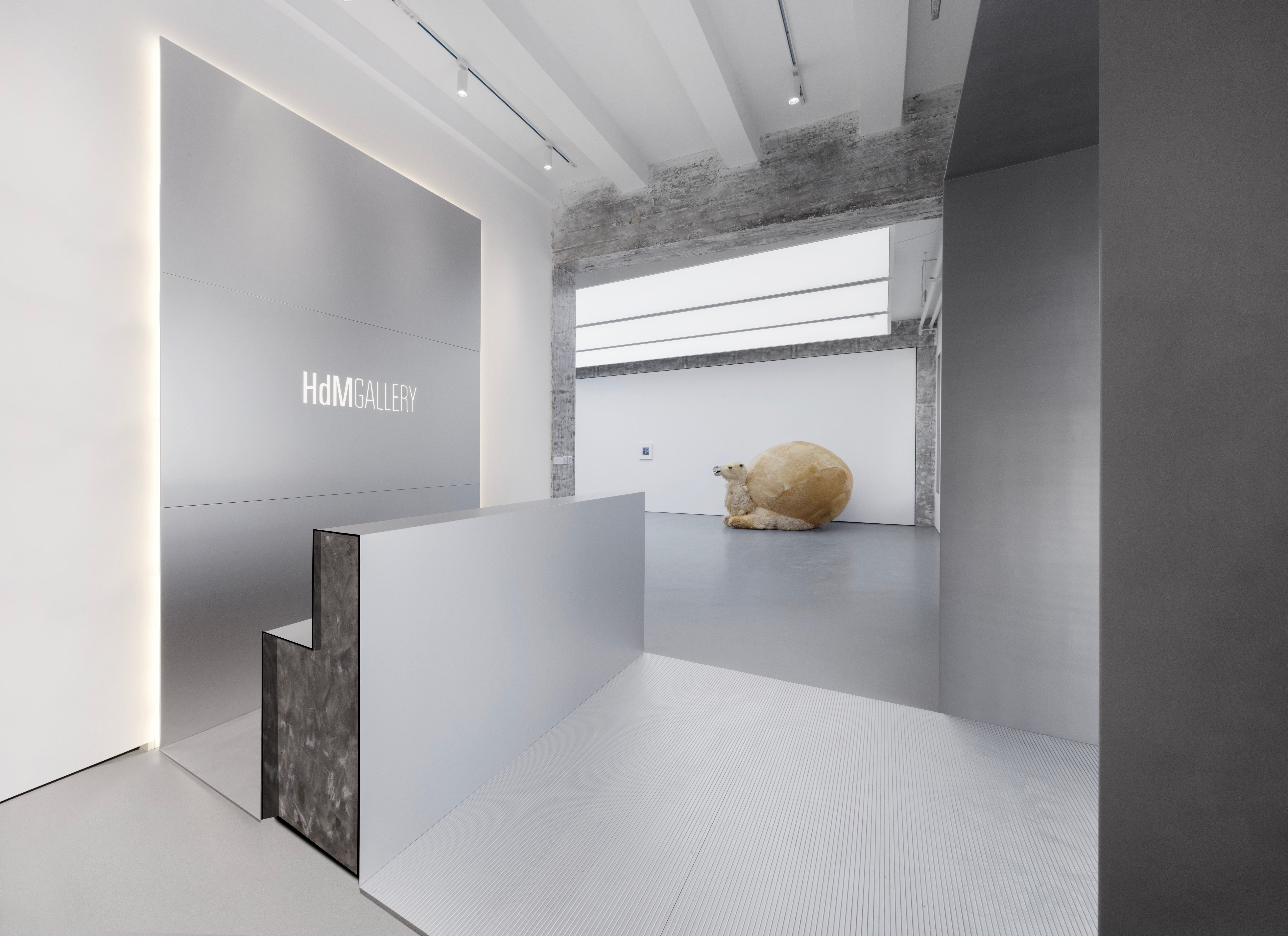
‘I have always been fascinated with the idea of using architecture to instil a sense of discovery that would be somewhat unexpected. As such, the relationship between exterior and interior is carefully differentiated in the framed moment of arrival, set to elegantly draw one into the interior. This is forged by a cohesive connection, immediately created in the single gesture of an aluminium tongue – grounded from the floor and continuing upwards to blend and manifest in a slick reflective front desk.’

Torquil then provided additional information, ‘To communicate a clear message and present a clean backdrop that would showcase the art to the best advantage, we have taken on a minimalist approach and our carefully selected core material palette is very limited. This is very much about a marriage of texture and tone, of greys and whites, with highlights of metallic silvers both brushed and polished, seen in conjunction with a hierarchy of light effects – simultaneously shadowless and focal. The overall gallery space is bright, and we have purposefully kept the original rooflight, creating a natural ‘studio’ light effect.
‘The functionality and agility of the space was a key consideration to support different configurations for the artwork displays, as well as providing spaces for private moments of contemplation and conversation. It was a consideration that the design foundation and ethos would be scalable.’
His statement provided insight into Sybarite’s mindset.
‘Sybarite’s vision was an exercise in purposefully pure and minimal detailing and the creation of beautifully contemporary and balanced framing, capturing an element of detachment from the existing structure, and providing a clean backdrop to showcase a diverse range of art.’

Even though Sybarite is a London-based architecture firm, to us, they seem to understand the Chinese spirit very well, as evidenced by Torquil’s subsequent description.
‘We are adept to working globally, especially in China, from our creative hub in London so that was a seamless process and of no concern. We built a masterplan in Chengdu over the pandemic remotely which was some feat in communication, design direction, and technological processes.
‘We needed to adhere to the Beijing 798 Art District authority’s planning requirements on preservation and colourways. This meant maintaining the existing brickwork on the façade wall. For the exterior, only whites and greys were permitted.
‘The project was conceived, designed, and delivered in a very short timeframe – a matter of months,’ The team of course faced some difficulty during the construction period.
‘The construction phase brought about certain unexpected discoveries, requiring creative solutions that did not compromise the overall design concept and vision. For example, existing pipework, that was uncovered in the floor and wall during partial demolition, needed to be rerouted and integrated to ensure an immaculate clean finish.
‘The design, essentially, was about the clean framing of apertures, the windows and the doors have the same design language of detailing and materials. We replaced the existing windows that were very derelict with aluminium framed glazing to the front of the façade. The idea was to curate a greater ‘inward’ looking perspective from the street level. Aluminium was chosen because it is a robust and versatile external material and created a textural contrast between the authentic rough brickwork wall, brushed aluminium metallic finishes, and exposed columns and beam structures inside the space.
‘We wanted to sensitively evolve the existing building without compromising the expanses to display art, making sure that there was generous space for private viewing and repose, meeting rooms, as well as a series of functional spaces that exist behind the scenes.’

Not only is he an architect who designs the project, but he is also an artist and art collector himself. We wonder what his vision is toward the world of art.
‘I have always gravitated to the arts and been fascinated with their interconnectedness. This continually informs my holistic approach to the projects that we undertake. To be able to blend all the art disciplines together is to deliver the best and most multi-faceted vision possible,’ said Torquil. ‘The combination of functionality and aesthetics distinguish architecture as a form of sculpture uniquely tied to the human experience and the built. In the end it is about the manipulation of form, space, and materials to create visually striking compositions. Buildings should be functional but also aesthetically pleasing, like monumental sculptures in the urban landscape.
‘Visiting galleries and museums is always on my agenda, some of my favourites are: The Hayward Gallery, London, The Guggenheim, New York, Centre Pompidou, Paris. I am fortunate to live in very close proximity to Hauser & Wirth in Bruton, Somerset. My taste gravitates towards early 20th Century arts onwards – Cubism, Surrealism, Abstract Expressionism.’

He then revealed to us about the recent piece in his collection. ‘I have recently acquired a piece of art from HdM Gallery by French multimedia artist Damien Deroubaix. I am drawn to his dark palette and vigorous brushstrokes and vivid images laden with symbolism.’
In our view, it seems that HdM Gallery has enhanced the charm of the district by its presence. If you have the chance to visit the 798 Art Zone in Beijing, we highly recommend that you go to HdM Gallery for your own benefit!
Project Name: HdM Gallery
Architect: Sybarite
Completion Year: 2023
Location: Beijing, China
Area: 410 sq.m.